6.18.2007

Strobist Style with a Nikon D70s

Before I start in earnest to work on Lighting 102 at Strobist I thought it would be a wise idea to review the various flash settings of the Nikon D70s for off-camera flash. Essentially, there are two ways off-camera flash can be controlled by the D70. Either wirelessly or tethered with PC cables and the like. Since one of the two flashes I have does not sport a PC connection nor do I want to spend extra time or cash to accommodate a PC connection, we'll talk only about wireless.
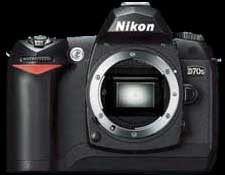
nikonD70s

What is Custom Setting 19?

This is the heart of the matter. You won't even see it unless you go to the Setup Menu (little icon that looks like a wrench) and select option 4 (CSM menu). There are two choices: Simple and Detailed. Select Detailed. This will give the Custom Settings menu (little icon that looks like a pencil) 16 additional settings to control. Oh boy! More stuff! It's like Christmas!

In the Custom Settings menu, option 19 Flash Mode, you have three choices ... TTL (Through The Lens) surrendering control to the camera and its exposure meter; Manual which sets the output level for the built-in speed light; and Commander Mode ... here's the sap in the tree! Commander Mode allows you to use the D70s' built-in speedlight to trigger remote flash units like the SB800 and/or the SB600. It is here we want to look further.

Commander Mode also has its own three options ... TTL: again surrendering control to the camera and its exposure meter; AA: (Auto Aperture, available only when CPU lens is used with SB-800), forget about it for right now ... that setting is still surrendering part of the exposure control to the camera; and M: (Manual Mode ... ooohh, aahhh) that's what I'm talkin' 'bout! Manual mode allows you to set the output level of your wireless, off-camera flashes from full power to 1/128th power. This is where we'll be working.

Now ... it's important to note that in wireless communication, perhaps we're talking about your laptop to a wireless router or your cordless phone, there are "channels" of communication. Literally, you set your device to a particular channel to communicate with another device or perhaps this one or both devices do this automatically. The Nikon D70s has no choices. It is permanently committed to communicate on Channel 3 ... whatever that means. You can't change it. There's no Custom Setting 26 or Commander Mode/Manual/Channel setting.

Let's move on ...

We should now have custom setting 19 Flash Mode set to Commander with Commander menu set to M (Manual) ... at this point you can choose any power output level say ... 1/16th power.

Now ... let's look at adding a flash unit to the mix. Keeping this simple for the time being, we'll look at an SB600. On the flash unit hold down the Zoom and the minus(-) sign together for 3 seconds or so to enter the Custom Settings menu for the flash unit. Press Mode until the the wireless symbol appears and press either the plus (+) or the minus (-) sign until the unit says "On." Hold down the Zoom and minus buttons together for 3 seconds or so to exit the Custom Settings menu.

Next press Mode to highlight the Channel setting on the flash and then +/- until it reads Channel 3 ... press Mode to highlight the Group setting and then +/- until it reads Group A. Raise the camera's built-in speedlight and test fire the camera. It should now trigger the flash even though the flash is not connected to the camera. In fact, it triggers the flash with an output level equivalent to the output setting you set on the camera ... Commander Mode/Manual/1/16th power.

Now, when you are setting up your shots for Strobist Lighting102 you can start with ...
  1. Set your shutter speed to 1/125th (or your choice of the other appropriate sync settings)
  2. Take a reading of ambient light (with the camera meter, of course)
  3. Set the aperture to underexpose 2 stops less than the ambient light reading
  4. Take a test shot (camera telling the flash to fire at 1/16th power)
  5. Adjust flash output using Commander Mode/Manual/power level until the exposure is correct
So that's it ... that's where we begin. That is officially our baseline for off-camera flash using a Nikon D70s and an SB600 Speedlight.

We'll keep it simple for now. For future posts we'll cover the setup for using two flash units with the D70s and then another post for using two flash units and controlling their output independently of the camera.

i shoot nikon

6.14.2007

Strobist Translated ... I hope.


We're on the verge of getting our first assignment in Strobist's summer boot camp Lighting 102. On that note, my goal is take part in each assignment and blog my experience. However, the equipment I'll be using will be different. So I want to translate what Strobist does to the language of Nikon's CLS (Creative Lighting System) equipment.

In other words, I'll be demonstrating how to capture the same concepts only using a D70s, an SB800, an SB600 and probably an SU800, wirelessly and in manual mode. Throw in a couple of stands, maybe an umbrella ... a DIY diffusion device ... who knows what else?

I've messed around with some of the things Strobist imparts but, have never spent the time really focusing on the execution and digging for the results. So I'm looking forward to a summer of learning ... and possibly helping others who may be struggling with techniques applied to Nikon equipment.

Happy lighting!

i shoot nikon

6.09.2007

Rain on the plain ...

Well ... there hasn't been too much to do since I committed myself to twiddling my thumbs until Strobist Lighting 102 really kicks in. It actually started five days ago with the first posting: Strobist: L102: Light Controls Overview. This is gonna be great.

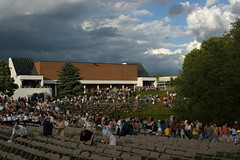
Until then, here's a little shoot I did on Thursday. It was graduation night at AHS a school that, by stupidity, flagrant disregard for human life ... er ... tradition, holds its graduation ceremony outside behind the school. Now this wouldn't normally be a concern if Minnesota was known for its incessantly consistent and pristine weather patterns. But, alas, it is not. This time of year offers a complete minestrone of climes never accurately predicted and always leaving one anxious and languished over the outcome.

None-the-less, we're having graduation with the potential of tornadoes and golf-ball sized hail. See?
We're in for a latter day Woodstock. Except the headliners are droning school admins and student honorees. On the bright side, we have a lot more places to take a piss in private.
The festivities were interrupted for about 20 minutes with some good soaking rain and 35 mph winds ... no hail or tornadoes.

So, we started with the processional a little late ... which played into our advantage as the School Principal cut a choral number and an orchestra number to keep us on track (can make it home in time to catch a rerun of Shark).

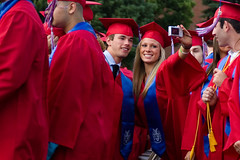
I got some nice pictures of the graduate and the family but, won't bore you with them here. Here are a couple of shots reaped from the event that I was pleased with.

I was shooting with my D70s fitted with my 28-105mm. My SB-800 fitted to the shoe set to TTL BL. There was still a good amount of ambient light to shoot with and the flash helped bolster ill-cast shadows even at 30 feet away. When I had time, I used Manual exposure mode otherwise shot in Aperture mode set at f/8.0. Seemed to work well with the distance from the subject.

i shoot nikon

5.31.2007

Exposure: Don't be a DFU.

I've read a lot of posts ... users exclaiming the exposure is off by a couple of stops on a lot of new or newer DSLR cameras. Well ... I'm not buyin' it!!!

The civilized world successfully conquered the principles of automated production well over a hundred years ago! And have spent the time since perfecting manufacturing quality and consistency. You can't tell me that the great many users experiencing variations in the manufacture of their DSLR's accurately represents the reliability of today's manufacturing process. There has to be something wrong with the user. Stand up, shake it off crybabies! Take responsibility for your craft! Stop blaming the equipment!!!

Instead ... start to understand the source of your own misconceptions ... do the math.

Just in manual mode alone ...


Shutter from 1' to 1/8000 - 1/3 stop increments = 42 possible settings
Aperture from f/3.5 - f/32 - 1/3 stop increments = 24 possible settings
Metering - 3D Matrix, Center Weighted, Spot = 3 possible settings
Format - JPEG (B,N,F) or NEF(RAW) or both = 5 possible settings
ISO - 200 to 1600 = 10 possible settings on a D70s

That, my friends means for every single exposure you make you have to decide which of the 151,200 possible settings works best for your shot! And that doesn't count all the other variations possible when you start using the camera settings to process jpegs! Sharpening, contrast, color reproduction, saturation, and hue (just to name a few) pushing the possibilities staggeringly over half-a-million choices!

You have to develop a working knowledge about exposure that allows you to quickly narrow your choices and zoom into the one ... I repeat ... the "one" that is the best for your shot. Here's my advice ...

Keep it as simple as possible. Set everything to default. Pick one format (I use NEF(RAW) and Adobe Lightroom for processing), use manual mode and learn about exposure. If you have already learned about exposure ... re-learn it! And most of all ... use your camera a lot and use it consciously - before and after image capture!

If all you want to do is plug your DSLR into a printer and get a bunch of 4x6 prints ... you bought way too much camera.

One of the better books I've read about exposure is Bryan Peterson's treatise entitled: Understanding Exposure: How to Shoot Great Photographs with a Film or Digital Camera. This book was originally released in 1990 and updated to its present 3rd edition supporting the growing nation of digital photographers.

Most of what he writes covers exactly the same thing you may have read about in innumerable printings before his. Smaller opening equals more DOF (depth of field), stop action with faster shutter speed ... blah blah blah. But he frames his teaching in very simple, practical terms that are easy to relate to and apply when shooting.

For example, he divides apertures into three groups: Story telling, who cares, and singular isolation.


  • Story Telling: Great depth of field where the foreground and background work together to capture the story ... both subject and environment are important to the image (f/16 and up).


  • Who Cares: Essentially, images where depth of field is of little concern ... subject up against a building or backdrop. Somewhere in the f/8 - f/11 range where the lens is sharpest.


  • Singular Isolation: You need just the subject ... no distractions from the surroundings. The closer to the subject the larger the aperture opening (f/2.8 to f/5.6) keeping the background out of focus.


These are principles that are quickly learned and applied out in the field. It can take a while to get them into practice but well worth the time and attention.

He also describes some very helpful techniques that are almost always available to you even when you don't have your camera! My personal favorites being Mr. Green Jeans and the Sky Brothers. I don't wanna spoil the ending but instead tell you that his approach is easy to understand, easy to remember, worth practicing and quick to success.

Others of you may have similar recommendations and are welcome to comment enlightening the rest of us.

Note: for the uninitiated ... DFU is programmer and help-desk speak for dumb fucking user.

i shoot nikon

5.27.2007

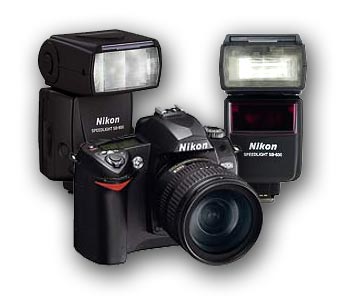
Nikon D70s an SB800 & SB600

I've seen a lot of posts in the forums, D70 owners asking about the capabilities of this equipment trio.

Here's what I know ... since I have all three and have played around with them for a couple of months now.

Both Flashes Off-camera using TTL


Set the D70/s to Commander mode (Custom Setting 19) which allows the camera to communicate with the flash units on Channel 3 Group A. This is the only Channel/Group option on the D70/s.

Set each flash to remote mode. On the SB800 press select for 3 seconds to access the custom options menu. Navigate to the wireless submenu and press select. Press + or - until Remote is highlighted and press Select. Press select for 3 seconds to exit the custom options menu. Press Select to navigate from channels to groups setting Channel 3 and Group A. On the SB600, press and hold the Zoom and - buttons for 3 seconds to access the custom settings menu. Press + or - to navigate to the wireless option. Press Mode to switch it on. Press and hold Zoom and - for 3 seconds to exit the custom options menu.

The camera has two more settings for controlling the flash units off-camera. Manual and AA (Auto Aperture). Auto Aperture can only be use with a CPU lens and an SB800. Manual mode in this setup can control the output level of the flash units simultaneously. In other words, setting the D70/s flash mode to Commander and selecting Manual submenu allows you to set the flash output to full and down to 1/128th power. Both flashes will output the fraction that the camera is set to.
This is a nice easy setup for wireless flash with Nikon equipment. Fairly flexible and will give you a lot of options albeit limited to equally distributed flash output.

With the SB800 on-camera


The SB800 mounted on the camera opens up a lot of other control features to the camera allowing you to configure the flash contribution of each flash separately. I assume that the same features and controls are available on the SU-800 flash controller except there's no flash gun.
So, the SB800 can control the SB600 setting its output level and setting its own level independently. You can choose whether the SB800 contributes to the exposure or not by setting its contribution level.

This is another great setup stepping up from the previous one in that it gives you the freedom to set flash output individually. However, there's still one flash on your camera. To achieve fuller freedom you'll have to look at working with 2 or more SB800's.


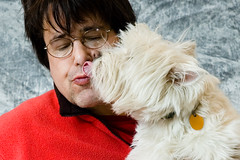
Here's an image I shot with the SB800 camera-left in an umbrella and the SB600 camera-right with a diffuser for the background.

Hopefully, this will help others decide what type of equipment to purchase for the setups they intend to employ. Overall, I'd have to say the SB600 is a great little flash and makes a great companion for the D70/s but, has its limitations when used off-camera. The SB800 is definitely a step up but, then demonstrates the camera's limitation in a wireless system. The only way to gain full flexibility with the camera is using either an SB800 on-camera or an SU-800 controller on-camera with another SB800. At least that would be in the Nikon world of wireless flash technology.

i shoot nikon